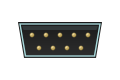
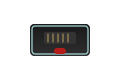
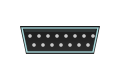
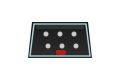
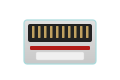
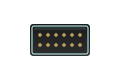
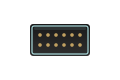
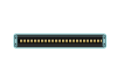
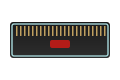
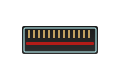
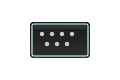
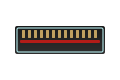
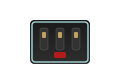
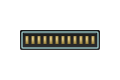
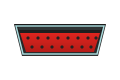
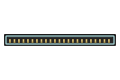
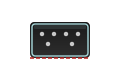
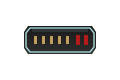
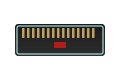
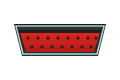
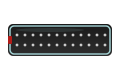
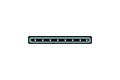
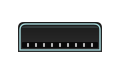
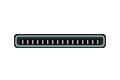
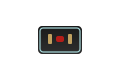
Nintendo Famicom (Family Computer) proprietary 15-pin controller expansion port. Used for external controllers and peripherals on the original Japanese console. This is a legacy connector specific to its console generation — no modern equivalent exists.
proprietary Connectors
Nintendo Famicom 48-pin expansion port on the front of the console for peripherals including the Disk System, keyboard, and third-party accessories. This is a legacy connector specific to its console generation — no modern equivalent exists.
Nintendo GameCube proprietary 6-pin controller port. Also used on the Wii (for backward compatibility) and on the Wii U/Switch via USB adapter. This is a legacy connector specific to its console generation — no modern equivalent exists.
Nintendo GameCube Hi-Speed Port for the Game Boy Player accessory, enabling Game Boy, Game Boy Color, and Game Boy Advance games on the TV. This is a legacy connector specific to its console generation — no modern equivalent exists.
Nintendo GameCube proprietary memory card slot accepting GameCube Memory Cards (59 blocks to 1019 blocks) for game save storage. This is a legacy connector specific to its console generation — no modern equivalent exists.
Nintendo GameCube high-speed serial port (SP1) on the bottom of the console. Used by the Broadband Adapter and Modem Adapter. This is a legacy connector specific to its console generation — no modern equivalent exists.
Nintendo GameCube serial port (SP2) on the bottom of the console. Used for SD card adapters and homebrew accessories. This is a legacy connector specific to its console generation — no modern equivalent exists.
The Surface Connect port appears on every Surface Pro (from Pro 3 onward) and Surface Laptop generation in an identical physical form factor. The connector is magnetic and reversible. Via the Surface Dock 2, it supports dual 4K@60Hz display output, USB 3.2 10Gbps data, and up to 120W of charging power. The port operates at 15V DC. Surface Connect does NOT support Thunderbolt — Surface devices with TB4 use their USB-C ports for that. The Surface Dock 3 (2023) switched to USB-C upstream, but the port remains on current Surface hardware.
Nintendo 64 bottom expansion connector for add-on hardware including the 64DD magnetic disk drive (Japan only). This is a legacy connector specific to its console generation — no modern equivalent exists.
Nintendo 64 top expansion port (memory/jumper pak slot) for the 4MB Expansion Pak RAM upgrade or standard Jumper Pak. This is a legacy connector specific to its console generation — no modern equivalent exists.
Nintendo Entertainment System proprietary 7-pin controller port. Accepts NES controllers and NES-compatible accessories. This is a legacy connector specific to its console generation — no modern equivalent exists.
Nintendo Entertainment System 48-pin expansion connector on the bottom of the console. Used for the Famicom-to-NES adapter and various peripherals. This is a legacy connector specific to its console generation — no modern equivalent exists.
Nintendo 64 proprietary controller port accepting N64 controllers and accessories. Features a unique 3-prong controller design. This is a legacy connector specific to its console generation — no modern equivalent exists.
Proprietary Controller Port (Xbox Original)
Microsoft's proprietary controller port on the original Xbox. Accepts Xbox controllers and accessories via the breakaway cable connection. This is a legacy connector specific to its console generation — no modern equivalent exists.
Proprietary Dock Connector (Nintendo Switch)
Although it looks like a standard USB-C port, Nintendo's dock connector uses a proprietary encrypted authentication protocol that blocks third-party docks. On the Switch 2, the console and official dock must exchange over 30 vendor-defined USB messages before video output is enabled — a deliberate barrier not present on any standard USB-C Alt Mode implementation. Standard USB-C charging works, but video output and full USB data require Nintendo's proprietary handshake. Third-party docks that worked with Switch 1 do not work with Switch 2. Only use official Nintendo docks or verified licensed accessories.
Proprietary Kinect Port (Xbox 360)
Proprietary Kinect sensor port on the Xbox 360 S and Xbox 360 E, combining USB data with 12V power for the Kinect motion sensor in a single connector. This is a legacy connector specific to its console generation — no modern equivalent exists.
Proprietary Kinect Port (Xbox One)
Proprietary Kinect port on the original Xbox One for the Kinect v2 sensor. Provides USB 3.0 SuperSpeed data plus 12V power in a single proprietary connector. This is a legacy connector specific to its console generation — no modern equivalent exists.
Proprietary Memory Unit Port (Xbox 360)
Proprietary memory unit slot on early Xbox 360 models accepting removable Xbox 360 Memory Units for game saves and profile storage. This is a legacy connector specific to its console generation — no modern equivalent exists.
Proprietary Storage Expansion Card Slot (Xbox Series X|S)
Proprietary CFexpress-based expansion card slot on Xbox Series X and Series S for the Seagate Storage Expansion Card, adding NVMe SSD storage matching internal drive speeds. This is a legacy connector specific to its console generation — no modern equivalent exists.
Proprietary XG Mobile Connector (ASUS ROG)
The ASUS XG Mobile connector delivers desktop-class eGPU performance through a proprietary cable carrying PCIe 3.0 x8 (63 Gbps theoretical), USB 3.2 Gen 2 (10 Gbps), and high-wattage power delivery. The cable internally terminates to two 40-pin FPC connectors and an 8-pin power connector. This connector was used on ROG Flow X13, Flow X16, Flow Z13, and ROG Ally (original 2023). The ROG Ally X switched to standard Thunderbolt 4, and the 2025 XG Mobile uses Thunderbolt 5 — making this proprietary connector a legacy interface for 2021-2024 ASUS hardware only.
Super Nintendo Entertainment System proprietary 7-pin controller port. Accepts SNES controllers, multitaps, and compatible accessories. This is a legacy connector specific to its console generation — no modern equivalent exists.
Super Nintendo 28-pin expansion port on the bottom of the console. Originally intended for an unreleased modem and CD-ROM add-on. This is a legacy connector specific to its console generation — no modern equivalent exists.
Proprietary 2-pin connector on the Nintendo Wii and Wii U for the infrared Sensor Bar. Provides power to the bar's IR LEDs for Wii Remote tracking. This is a legacy connector specific to its console generation — no modern equivalent exists.