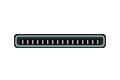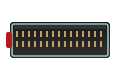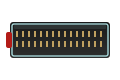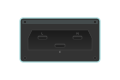
3.5mm Composite A/V Out (Xbox 360 E)

3.5mm TRRS jack on the Xbox 360 E carrying composite video and stereo audio. Requires a proprietary 3.5mm-to-RCA breakout cable for TV connection. See below for full technical specs, compatible cables, and devices that use this connector.

3.5mm TRRS (Headset with Mic)

The 3.5mm TRRS (Headset with Mic) is the standard headset jack supporting stereo audio plus a microphone channel. Found on smartphones, laptops, gaming headsets, and tablets. The four-conductor TRRS design carries left audio, right audio, ground, and mic on a single 3.5mm plug. Uses the CTIA pinout standard on most modern devices.

3.5mm TRS (Stereo Audio)

The 3.5mm TRS (Stereo Audio) is the universal headphone and aux cable connector — the most common audio port on consumer electronics. The three-conductor TRS design carries stereo audio (left, right, ground). Found on TVs, monitors, laptops, speakers, and amplifiers. No microphone support — for headsets with mics, look for the 4-pole TRRS variant.

5-pin DIN MIDI

The 5-pin DIN connector has been the standard MIDI interface since 1983 and remains ubiquitous on audio interfaces, synthesizers, drum machines, and MIDI controllers. It uses a 180° pin layout (DIN 41524 / IEC 60130-9) with a 13.2mm metal shield skirt that ensures correct orientation. Although all five pins are physically present, MIDI uses only three — pin 2 for shield/ground, pin 4 as current source (+5V), and pin 5 as current sink. Pins 1 and 3 carry no signal in standard MIDI. Some manufacturers use 5-pin DIN for analog audio (hi-fi equipment uses all 5 pins differently), so context matters when identifying DIN connectors.

6.35mm TRS (1/4 inch Audio)

The 6.35mm TRS (1/4 inch Audio) is the standard connector for professional and hi-fi audio equipment. Found on studio headphones, guitar amplifiers, mixing consoles, and high-end audio interfaces. Electrically identical to 3.5mm TRS but physically larger at 6.35mm diameter — a simple adapter converts between the two sizes.

Coaxial S/PDIF (RCA Digital)

The Coaxial S/PDIF (RCA Digital) carries S/PDIF digital audio over a copper coaxial cable using an RCA plug. Supports the same formats as optical TOSLINK — up to 5.1 surround (compressed). Slightly more reliable than optical for long runs and less fragile physically. Found on AV receivers, CD players, and some TVs as a digital audio output.

Component Video (RCA YPbPr)

The Component Video (RCA YPbPr) uses three RCA connectors (green Y, blue Pb, red Pr) for analog HD video. Supports up to 1080p by separating luminance from color difference signals. The best analog video connection available — common on PS2/PS3, Xbox 360, and older HDTVs. Video only — you need separate RCA audio cables for sound.

Composite Video (3.5mm Mini Jack)

This Composite Video (3.5mm Mini Jack) combines composite video and stereo audio into a single 3.5mm TRRS jack. Maximum resolution is 480i. Used on some compact devices as a space-saving AV output that breaks out to standard RCA connectors via a proprietary cable. Found on select consoles and portable devices.

Composite Video (RCA)

The Composite Video RCA connector carries all video information as a single analog signal — typically on a yellow RCA plug. Maximum resolution is 480i (standard definition only). The simplest and most universal legacy video connection, found on VCRs, older game consoles, and budget equipment. Poor image quality compared to component or HDMI.

DisplayPort 1.2

DisplayPort 1.2 supports 21.6Gbps bandwidth for 4K@60Hz video and introduced MST daisy-chaining for multi-monitor setups. Still found on older monitors and GPUs, it handles 1080p@144Hz gaming and dual 1080p displays through a single output. The 20-pin connector has the same physical shape as DP 1.4 and 2.1 — the version determines bandwidth and features.

DisplayPort 1.4

DisplayPort 1.4 delivers 32.4Gbps bandwidth for 8K@30Hz or 4K@120Hz with DSC compression. This is the current mainstream DisplayPort version on gaming monitors, professional displays, and most desktop graphics cards. It supports MST daisy-chaining, HDR10, and HDCP 2.2. The full-size connector has a locking mechanism that clicks into place — more secure than HDMI.

DisplayPort 2.1

DisplayPort 2.1 is the latest display interface standard, offering up to 80Gbps bandwidth for 8K@60Hz or 4K@240Hz with DSC compression. It's the connector for high-refresh gaming monitors and 8K professional displays arriving in 2024-2025. Supports HDCP 2.3 content protection and MST daisy-chaining for multi-monitor setups from a single output.

DVI-D (Dual Link)

The DVI-D (Dual Link) carries digital-only video at up to 7.92Gbps bandwidth for 2560x1600@60Hz. The dual-link variant uses all 24+1 pins for maximum resolution. Common on older monitors, GPUs, and professional displays. No audio support — pair with a separate audio cable. Being replaced by DisplayPort and HDMI.

DVI-I (Dual Link)

The DVI-I (Dual Link) carries both digital and analog video signals at up to 7.92Gbps bandwidth. The extra pins support a VGA-compatible analog signal through a simple passive adapter. Found on older GPUs and KVM switches. 2560x1600@60Hz maximum resolution in digital mode. The 'I' stands for Integrated — both digital and analog in one connector.

Famicom Controller Port

Nintendo Famicom (Family Computer) proprietary 15-pin controller expansion port. Used for external controllers and peripherals on the original Japanese console. This is a legacy connector specific to its console generation — no modern equivalent exists.

Famicom Expansion Port

Nintendo Famicom 48-pin expansion port on the front of the console for peripherals including the Disk System, keyboard, and third-party accessories. This is a legacy connector specific to its console generation — no modern equivalent exists.

GameCube Controller Port

Nintendo GameCube proprietary 6-pin controller port. Also used on the Wii (for backward compatibility) and on the Wii U/Switch via USB adapter. This is a legacy connector specific to its console generation — no modern equivalent exists.

GameCube Hi-Speed Port

Nintendo GameCube Hi-Speed Port for the Game Boy Player accessory, enabling Game Boy, Game Boy Color, and Game Boy Advance games on the TV. This is a legacy connector specific to its console generation — no modern equivalent exists.

GameCube Memory Card Slot

Nintendo GameCube proprietary memory card slot accepting GameCube Memory Cards (59 blocks to 1019 blocks) for game save storage. This is a legacy connector specific to its console generation — no modern equivalent exists.

GameCube Serial Port 1

Nintendo GameCube high-speed serial port (SP1) on the bottom of the console. Used by the Broadband Adapter and Modem Adapter. This is a legacy connector specific to its console generation — no modern equivalent exists.

GameCube Serial Port 2

Nintendo GameCube serial port (SP2) on the bottom of the console. Used for SD card adapters and homebrew accessories. This is a legacy connector specific to its console generation — no modern equivalent exists.

HDMI 1.4 (Type A – Standard)

The HDMI 1.4 (Type A - Standard) supports 10.2Gbps bandwidth for 4K@30Hz or 1080p@60Hz video with ARC audio. Still found on millions of TVs, projectors, and budget devices, this is the baseline HDMI version for HD content. It handles 3D video and introduced the Audio Return Channel (ARC). The physical connector is identical to HDMI 2.0 and 2.1 — only the capabilities differ.

HDMI 2.0b (Type A – Standard)

The HDMI 2.0b (Type A - Standard) delivers 18Gbps bandwidth for 4K@60Hz video with full HDR support. This is the mainstream HDMI port on most 4K TVs, Blu-ray players, and streaming boxes from 2015 onward. It supports ARC (Audio Return Channel) for sending TV audio to a soundbar over a single cable. Same physical shape as HDMI 1.4 and 2.1 — the version determines what it can do, not how it looks.

HDMI 2.1 (Type A – Standard)

The HDMI 2.1 (Type A - Standard) is the current top-tier HDMI connector, supporting up to 48Gbps bandwidth for 8K@60Hz video with Fixed Rate Link (FRL) signaling. It's the port you'll find on PS5, Xbox Series X, and 2021+ 4K TVs — required for 4K@120Hz gaming with VRR and ALLM. Backward compatible with all older HDMI versions using the same Type A plug shape. Below you'll find full specs and every cable that fits this connector.


Item added to cart.
0 items - 0,00