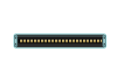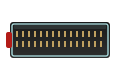
The HDMI Mini (Type C) is a smaller version of the standard HDMI plug, commonly found on DSLR cameras, camcorders, and some tablets. It supports up to 18Gbps bandwidth for 4K@60Hz video. You'll need a Mini HDMI to standard HDMI cable to connect to a TV or monitor. Same electrical specs as full-size HDMI 2.0 — just physically smaller at 10.42mm × 2.42mm.
Connectors
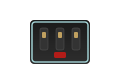
The IEC C14 is one of the most common power connectors in consumer and professional electronics — the rectangular inlet accepting the standard 'kettle cord' (C13 plug). Found on studio monitors (KRK ROKIT, Yamaha HS, Genelec), audio interfaces (Focusrite Scarlett 18i20), NAS devices, AV receivers, and desktop computers. Three-pin grounded (line, neutral, earth) rated 10A/250VAC internationally or 15A/250VAC North America. Sometimes called a 'kettle plug' though technically the C15/C16 high-temperature variant is the true kettle connector. Not interchangeable with the 2-pin C8 (figure-8) inlet.
The IEC C8 (Figure-8 Inlet) is a 2-pin power inlet for devices with internal power supplies. Uses a detachable C7 'figure-8' power cord — one of the most common power cables in electronics. Found on streaming devices, small projectors, laptop chargers, and audio equipment. Supports universal AC input (100-240V, 50/60Hz) for worldwide use.
The IR Blaster (3.5mm) is a 3.5mm jack that outputs infrared control signals to other devices. Found on some smart TVs and AV receivers for controlling external equipment. The IR emitter cable plugs in here and is placed near the target device's IR sensor. Useful for universal remote setups and whole-room AV automation.
The Kensington Security Slot is a small T-shaped hole (7mm × 3mm) for attaching a physical cable lock. Found on laptops, monitors, docking stations, and projectors. Not a data port — it's a theft-deterrent anchor point for securing equipment in offices, libraries, and public spaces. Standard across virtually all business-class devices.
Lightning is Apple's proprietary 8-pin reversible connector at 480Mbps data speed. Found on iPhone 14 and earlier, older iPads, AirPods cases, and Apple accessories. Supports up to Up to 20W and carries audio through supported adapters. Apple has moved to USB-C starting with iPhone 15 — Lightning is a legacy connector that still works on millions of active devices.
The Micro HDMI (Type D) is the smallest HDMI connector, used on Raspberry Pi, GoPro cameras, drones, and some thin handheld devices. It carries up to 18Gbps bandwidth for 4K@60Hz video. You'll need a Micro HDMI to standard HDMI cable to connect to any display. Physically tiny at 6.4mm × 2.8mm — easy to damage, so handle with care.
The MicroSD Card Slot reads microSD cards at up to 104MB/s (UHS-I maximum). Found on smartphones, tablets, Nintendo Switch, and budget laptops. The most common removable storage slot on portable electronics. Accepts all microSD, microSDHC, and microSDXC cards.
The MicroSD Card Slot (UHS-II) supports transfer speeds up to 312MB/s with UHS-II cards. Found on high-end cameras, drones, and premium handheld devices. Backward compatible with UHS-I and standard microSD cards at lower speeds. The tiny 15mm × 11mm form factor is the most popular removable storage for portable devices.
The Surface Connect port appears on every Surface Pro (from Pro 3 onward) and Surface Laptop generation in an identical physical form factor. The connector is magnetic and reversible. Via the Surface Dock 2, it supports dual 4K@60Hz display output, USB 3.2 10Gbps data, and up to 120W of charging power. The port operates at 15V DC. Surface Connect does NOT support Thunderbolt — Surface devices with TB4 use their USB-C ports for that. The Surface Dock 3 (2023) switched to USB-C upstream, but the port remains on current Surface hardware.
Mini DisplayPort 1.4 delivers 32.4Gbps bandwidth for 8K@30Hz or 4K@120Hz with DSC in a compact plug. Found on Microsoft Surface devices, some MacBooks (2011-2016), and compact GPUs. Electrically identical to full-size DisplayPort 1.4 — just needs a Mini DP to DP cable for connecting to standard monitors. Supports MST daisy-chaining and HDR10.
Mini DisplayPort 2.1 packs the full 80Gbps bandwidth of DisplayPort 2.1 into a compact form factor. Supports 8K@60Hz video and 4K@240Hz with DSC. Found on select high-end laptops and workstations where space is at a premium. Electrically identical to full-size DP 2.1 — you just need a Mini DP to DP cable or adapter to connect to standard DisplayPort monitors.
Nintendo 64 bottom expansion connector for add-on hardware including the 64DD magnetic disk drive (Japan only). This is a legacy connector specific to its console generation — no modern equivalent exists.
Nintendo 64 top expansion port (memory/jumper pak slot) for the 4MB Expansion Pak RAM upgrade or standard Jumper Pak. This is a legacy connector specific to its console generation — no modern equivalent exists.
Nintendo Entertainment System proprietary 7-pin controller port. Accepts NES controllers and NES-compatible accessories. This is a legacy connector specific to its console generation — no modern equivalent exists.
Nintendo Entertainment System 48-pin expansion connector on the bottom of the console. Used for the Famicom-to-NES adapter and various peripherals. This is a legacy connector specific to its console generation — no modern equivalent exists.
Nintendo 64 proprietary controller port accepting N64 controllers and accessories. Features a unique 3-prong controller design. This is a legacy connector specific to its console generation — no modern equivalent exists.
The Nintendo AV Multi Out is Nintendo's proprietary multi-signal video connector used across SNES, N64, and GameCube consoles. Supports composite, S-Video, and component video up to 480p. Requires a console-specific AV cable that breaks out to standard RCA connectors for TV connection. Same physical plug across three console generations.
The Nintendo Digital AV Out is the Wii's proprietary video output supporting both analog and digital signals up to 1080p. Found exclusively on the original Wii model (RVL-001). Supports component video for 480p progressive scan — the highest quality available from the Wii. The Wii Mini (RVL-201) removed this port, leaving only composite output.
The Optical TOSLINK (S/PDIF) carries digital audio over fiber optic cable, immune to electrical interference. Supports up to 5.1 surround sound (compressed Dolby Digital/DTS) or 2-channel PCM stereo. The most common connection between TVs and soundbars. Cannot carry lossless Dolby Atmos — for that, you need HDMI with eARC support.
Proprietary AV Multi-Out (Xbox 360 Slim)
The Proprietary AV Multi-Out (Xbox 360 Slim) is the dedicated AV output on the Xbox 360 S (Slim) model, supporting component and composite video up to 1080p. Required a proprietary Xbox 360 AV cable that breaks out to standard connectors. The Slim also has HDMI — use that instead unless connecting to a TV without HDMI input.
Proprietary AV Multi-Out (Xbox 360)
The Proprietary AV Multi-Out (Xbox 360) is the dedicated AV output on the original Xbox 360 (fat model), supporting component, composite, S-Video, and VGA output up to 1080p through proprietary breakout cables. This port was the primary video output before HDMI was added in later revisions. Multiple cable options provided flexible connections to different TV types.
Proprietary AV Multi-Out (Xbox Original)
The Proprietary AV Multi-Out (Xbox Original) is the sole video output on the original Xbox, carrying component, composite, and S-Video signals up to 1080i. Requires a proprietary Xbox AV cable pack. Component output enabled HD gaming on supported titles — a rarity for its era. The original Xbox had no HDMI — third-party HDMI adapters now exist for retro setups.
Proprietary Controller Port (Xbox Original)
Microsoft's proprietary controller port on the original Xbox. Accepts Xbox controllers and accessories via the breakaway cable connection. This is a legacy connector specific to its console generation — no modern equivalent exists.