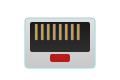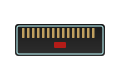
Proprietary Dock Connector (Nintendo Switch)

Although it looks like a standard USB-C port, Nintendo's dock connector uses a proprietary encrypted authentication protocol that blocks third-party docks. On the Switch 2, the console and official dock must exchange over 30 vendor-defined USB messages before video output is enabled — a deliberate barrier not present on any standard USB-C Alt Mode implementation. Standard USB-C charging works, but video output and full USB data require Nintendo's proprietary handshake. Third-party docks that worked with Switch 1 do not work with Switch 2. Only use official Nintendo docks or verified licensed accessories.


Proprietary Kinect Port (Xbox 360)

Proprietary Kinect sensor port on the Xbox 360 S and Xbox 360 E, combining USB data with 12V power for the Kinect motion sensor in a single connector. This is a legacy connector specific to its console generation — no modern equivalent exists.

Proprietary Kinect Port (Xbox One)

Proprietary Kinect port on the original Xbox One for the Kinect v2 sensor. Provides USB 3.0 SuperSpeed data plus 12V power in a single proprietary connector. This is a legacy connector specific to its console generation — no modern equivalent exists.

Proprietary Memory Unit Port (Xbox 360)

Proprietary memory unit slot on early Xbox 360 models accepting removable Xbox 360 Memory Units for game saves and profile storage. This is a legacy connector specific to its console generation — no modern equivalent exists.

Proprietary Power Connector (NVIDIA Shield TV Pro)

The NVIDIA Shield TV Pro (2019) features a power port that has the same external appearance as USB-C but is a proprietary DC connection. It cannot accept standard USB-C PD chargers. NVIDIA has not publicly released the connector's pin configuration or voltage specifications. Replacement power adapters must be sourced from NVIDIA or authorized retailers. The included adapter provides approximately 25-30W. Unlike the Shield TV Tube, this connector is power-only with no data capability.

Proprietary Power Connector (Xbox 360 E)

The Proprietary Power Connector (Xbox 360 E) is a proprietary DC power inlet rated at 120W DC. Microsoft's proprietary DC power connector on the Xbox 360 E. Connects to a 120W external power supply unit. Only compatible with the specific Xbox model's power supply unit — not interchangeable across generations.

Proprietary Power Connector (Xbox 360 Original)

The Proprietary Power Connector (Xbox 360 Original) is a proprietary DC power inlet rated at 203W DC. Microsoft's proprietary DC power connector on the original Xbox 360. Connects to the external 203W power supply unit with a dedicated power brick. Only compatible with the specific Xbox model's power supply unit — not interchangeable across generations.

Proprietary Power Connector (Xbox 360 Slim)

The Proprietary Power Connector (Xbox 360 Slim) is a proprietary DC power inlet rated at 135W DC. Microsoft's proprietary DC power connector on the Xbox 360 S (Slim). Connects to a smaller 135W external power supply unit. Only compatible with the specific Xbox model's power supply unit — not interchangeable across generations.

Proprietary Power Connector (Xbox One Original)

The Proprietary Power Connector (Xbox One Original) is a proprietary DC power inlet rated at 220W DC. Microsoft's proprietary DC power connector on the original Xbox One. Connects to a large external 220W power supply unit. Only compatible with the specific Xbox model's power supply unit — not interchangeable across generations.

Proprietary Storage Expansion Card Slot (Xbox Series X|S)

Proprietary CFexpress-based expansion card slot on Xbox Series X and Series S for the Seagate Storage Expansion Card, adding NVMe SSD storage matching internal drive speeds. This is a legacy connector specific to its console generation — no modern equivalent exists.

Proprietary XG Mobile Connector (ASUS ROG)

The ASUS XG Mobile connector delivers desktop-class eGPU performance through a proprietary cable carrying PCIe 3.0 x8 (63 Gbps theoretical), USB 3.2 Gen 2 (10 Gbps), and high-wattage power delivery. The cable internally terminates to two 40-pin FPC connectors and an 8-pin power connector. This connector was used on ROG Flow X13, Flow X16, Flow Z13, and ROG Ally (original 2023). The ROG Ally X switched to standard Thunderbolt 4, and the 2025 XG Mobile uses Thunderbolt 5 — making this proprietary connector a legacy interface for 2021-2024 ASUS hardware only.

RCA Audio (Mono)

The RCA Audio (Mono) is a single RCA connector carrying one channel of analog audio. Used for subwoofer/LFE outputs on AV receivers, mono audio connections, and legacy equipment. The standard color coding is white or black for mono. Found on soundbars with sub-out, turntable pre-amps, and older audio equipment.

RCA Stereo Audio

The RCA Stereo Audio is the red/white RCA pair for two-channel analog audio. A staple of home theater since the 1970s, found on AV receivers, turntables, soundbars, and older TVs. Red carries right channel, white carries left. Pure analog — no processing delay, but limited to stereo (no surround sound).

RF Antenna Input (Coaxial)

The RF Antenna Input (Coaxial) is the threaded coaxial connector for antenna and cable TV signals. Supports broadcast TV up to 1080i through analog and digital tuner processing. Found on every TV with a built-in tuner, cable boxes, and antenna distribution systems. Uses 75-ohm F-type coaxial cable — the same connector since the 1970s.

RJ-45 (100BASE-TX Fast Ethernet)

The RJ-45 (100BASE-TX Fast Ethernet) supports 100Mbps Fast Ethernet — the minimum viable wired network speed. Found on budget smart TVs, older streaming devices, and legacy network equipment. Same physical RJ-45 connector as Gigabit, but runs 10× slower. If your device has this instead of Gigabit, 4K streaming may buffer on wired connections.

RJ-45 (10GBASE-T Ethernet)

The RJ-45 (10GBASE-T Ethernet) supports 10Gbps networking for high-performance workstations, NAS systems, and servers. Requires Cat 6a or better cabling for full speed at 100m. Same physical RJ-45 plug as Gigabit Ethernet but with tighter signal requirements. Overkill for home use unless you're running a serious NAS or editing 4K video over the network.

RJ-45 (2.5G Ethernet)

The RJ-45 (2.5G Ethernet) supports 2.5Gbps speeds — 2.5× faster than Gigabit over the same Cat 5e cable. Found on newer gaming motherboards, high-end laptops, and NAS devices. Uses the same physical RJ-45 plug as Gigabit Ethernet. Backward compatible with 1Gbps, 100Mbps, and 10Mbps networks.

RJ-45 (Gigabit Ethernet)

The RJ-45 (Gigabit Ethernet) is the standard wired network connector supporting up to 1Gbps speeds. Found on laptops, desktops, TVs, gaming consoles, and streaming devices. Uses the 8P8C modular plug on Cat 5e or better Ethernet cable. Gigabit Ethernet is the baseline for reliable streaming, gaming, and file transfers — faster and more stable than Wi-Fi for stationary devices.

SD Card Slot (UHS-I)

The SD Card Slot (UHS-I) reads full-size SD cards at up to 104MB/s (UHS-I maximum). Found on laptops, cameras, and some monitors with built-in card readers. Accepts SD, SDHC, and SDXC cards. For faster transfer speeds, look for UHS-II slots. The full-size SD slot is being dropped from many thin laptops in favor of microSD or USB readers.

SD Card Slot (UHS-II)

The SD Card Slot (UHS-II) supports transfer speeds up to 312MB/s with UHS-II SD cards. Found on high-end laptops, pro cameras, and video editing workstations. The extra row of pins on UHS-II cards enables faster burst transfers for RAW photos and 4K video. Backward compatible with UHS-I and standard SD cards.

SNES Controller Port

Super Nintendo Entertainment System proprietary 7-pin controller port. Accepts SNES controllers, multitaps, and compatible accessories. This is a legacy connector specific to its console generation — no modern equivalent exists.

SNES Expansion Port

Super Nintendo 28-pin expansion port on the bottom of the console. Originally intended for an unreleased modem and CD-ROM add-on. This is a legacy connector specific to its console generation — no modern equivalent exists.

Thunderbolt 3 (USB-C)

Thunderbolt 3 offers 40Gbps bandwidth through a USB-C connector, supporting dual 4K@60Hz displays and Up to 100W (USB PD 3.0). The original USB-C Thunderbolt standard, found on MacBooks (2016+), Dell XPS, and high-end laptops from 2016-2020. Note: passive cables max out at 40Gbps for only 0.5m — longer passive cables drop to 20Gbps. Active cables maintain full speed at longer lengths.

Thunderbolt 4 (USB-C)

Thunderbolt 4 delivers 40Gbps bandwidth through a USB-C connector, with mandatory support for dual 4K displays or a single 8K display. It's Intel's certified standard requiring PCIe tunneling, DP Alt Mode video, and Up to 100W (USB PD 3.0). Every Thunderbolt 4 port is also a fully compliant USB4 port. Found on most premium laptops and desktops from 2021 onward.

Item added to cart.
0 items - 0,00